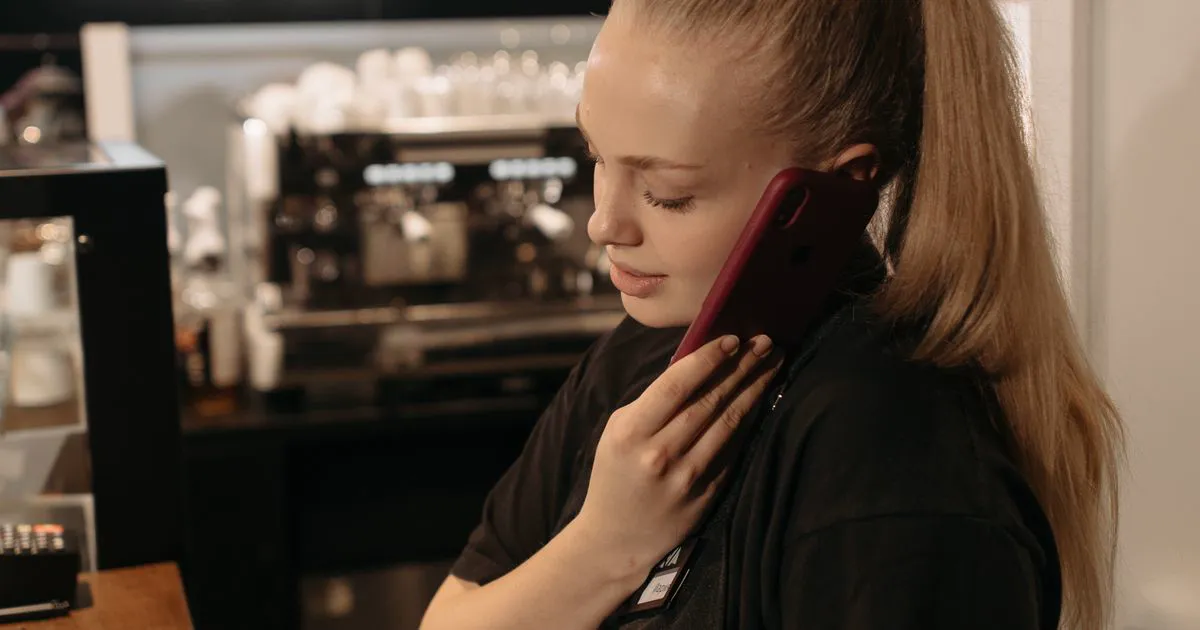
A customer calls your restaurant. Do you have someone — or something — take the order right there on the phone, or do you answer, say “you can order online,” and text them a link? Both are legitimate ordering channels. The question worth asking isn't which one is better in general — it's which one wins the call that's already ringing.
What online ordering does well
A website or app ordering page is genuinely good at what it does. It costs you nothing per order to keep open, a customer can browse the full menu with photos and modifiers at their own pace, and it doesn't care how many people order at 7:12pm on a Friday. For a customer who already knows what they want and has the app open, it's often faster than talking to anyone.
Where it falls short for a phone call specifically
The catch is that someone who already picked up the phone has, by definition, not chosen the app. Redirecting them costs a step — and every extra step between a hungry customer and a placed order is a place they can drop off:
- They may not have a smartphone in hand.Driving, at work, an older customer, a shared landline — a text link assumes a device and a moment of free attention that isn't always there.
- It turns one interaction into two.Answer, explain, hang up, wait for the text, open it, rebuild the order from scratch. Some callers will finish it. Some will decide it's easier to just call the next place.
- It doesn't answer the question they called with.“Is the tikka masala spicy?” or “are you open for one more pickup?” needs a real answer before a link is useful at all.
What live AI order taking does well
AI phone order taking — a voice agent like Depla that holds the actual conversation and places the order before the call ends — is built for exactly the gap above. It answers questions on your real menu, takes the order the way a caller wants to give it (out of order, with substitutions, mid-sentence changes), confirms it back, and drops it straight into your dashboard. Nothing to open, nothing to rebuild. The order is placed by the time the call ends, the same way it would be if a staff member had picked up.
Where it falls short
A live conversation is not always the fastest path for every caller. Someone who wants to scroll a full menu with photos, stack a large catering order, or reorder “the usual from last week” from history is often better served by a screen they control. Voice is a poor interface for browsing; it's a good interface for deciding and confirming.
The honest answer: it's not either/or
Framing this as a single winner misses how restaurants actually use both. The strongest setup we see is AI order taking as the default for anyone who calls — because a ringing phone is a customer who wants to talk to someone right now — with online ordering available as the self-serve option for people who'd rather browse. A caller who says “can you just text me the link” should get exactly that, not a script forcing them to stay on the line. The channel should follow the customer's preference, not the other way around.
What that setup avoids is the failure mode both channels share on their own: a call that goes unanswered captures nothing, and a text link that never gets opened captures nothing either. Whichever channel a customer starts in, the goal is the same — don't let the order die in the handoff.
Where Depla lands
Depla answers every call and takes the full order live on your real menu — no forced redirect, no dead air, no per-order fee for using it. If a caller would rather order online, that's still available; Depla just makes sure the ones who called to talk to someone don't get lost in between. See how it sounds on your own menu with the live demo.